
What Elbert County Deed Records Convey
The Elbert County Clerk of Superior Court serves as the county's recorder. A deed marks a transfer entered into the official record. Its warranties and legal force come from the instrument itself. Later filings can correct, release, or burden that same interest.
| Deed Type | What It Does | Common Use |
|---|---|---|
| Warranty deed | Transfers an interest with broad title promises. | Conventional sale |
| Limited warranty deed | Limits the grantor's promises to a stated period or acts. | Some institutional sales |
| Quitclaim deed | Transfers whatever interest exists without a title warranty. | Interest cleanup or family transfer |
| Correction deed | Corrects a stated error in a prior instrument. | Name or description correction |
| Trustee / executor deed | Transfers through an authorized fiduciary. | Trust, estate, or power-of-sale matter |
A security deed, for instance, secures debt rather than selling land outright. Liens, lis pendens, easements, covenants, assignments, cancellations, and releases can all touch the same tract. That is why a thorough deed search follows the transfer and every related filing after it.
Walk Elbert County's Grantor-Grantee Index
The GSCCCA name search lets you filter by party type, instrument type, county, and neighboring counties, plus name, date range, and display choices. Individuals are entered last name first. Compare the legal description at every turn.
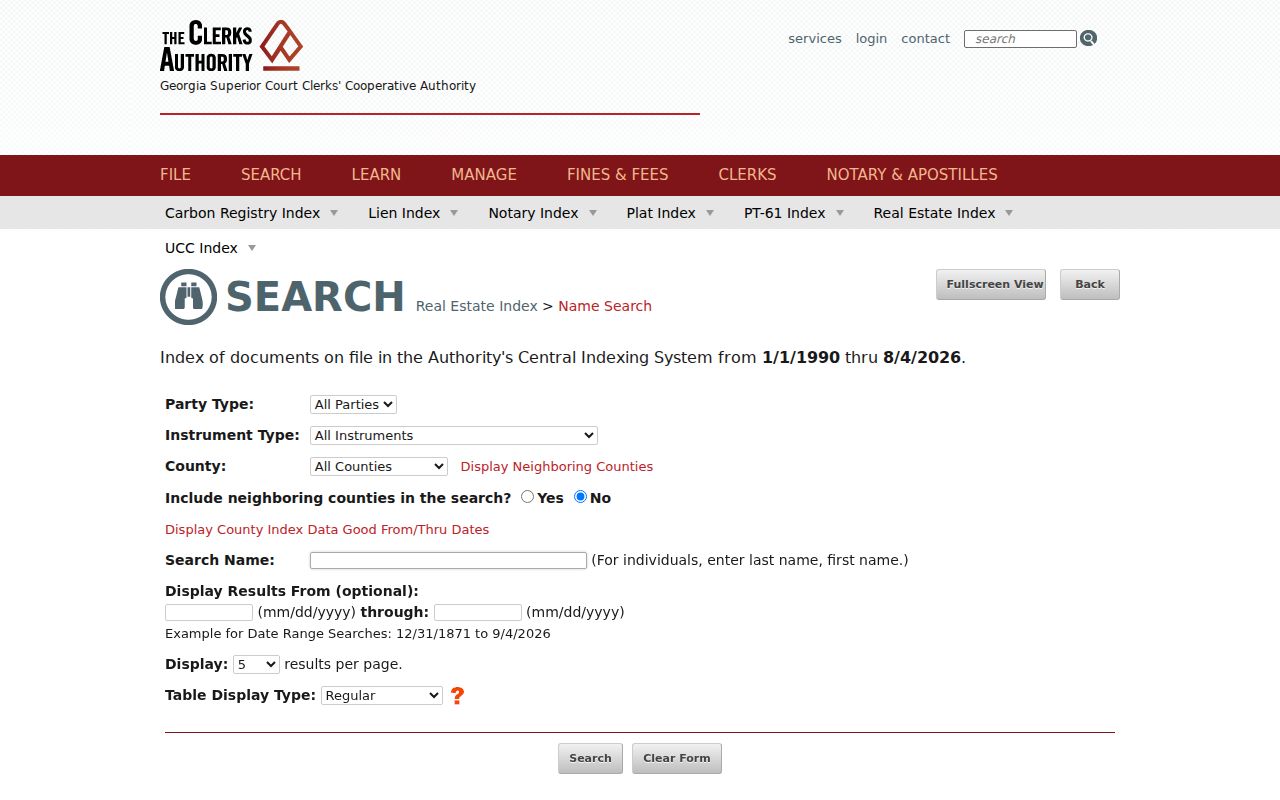
The search controls narrow a chain quickly, but every result still has to be matched to the land itself.
- Find the current owner's acquiring deed, with that owner as grantee.
- Read the grantor, recording date, book/page, and legal description.
- Search that grantor as an earlier grantee and test the land description.
- Repeat until the web index ends, then continue in deed books or microfilm.
- Grantor
- The party transferring the stated interest.
- Grantee
- The party receiving it.
- Chain of title
- The linked sequence of instruments affecting the same land.
- Book/page vs instrument number
- Two distinct references used to locate a filed document.
Read Elbert County GSCCCA Search Fields
Party type splits grantors from grantees, and instrument type separates deeds from security deeds, corrections, and other filings. Pick Elbert County and a tight date range whenever a name is common. For a known citation, the separate book/page search demands both fields.
| Result field | What it supplies | Verification |
|---|---|---|
| Party and role | Grantor and grantee names | Compare capacity and spelling |
| Instrument type | The indexed document class | Read the image |
| Recording date | When the clerk filed it | Keep separate from execution date |
| Book/page | County filing location | Use for a copy request |
| Property/PT-61/image | Available land, transfer, or scan links | Availability depends on record and account |
The standard index covers every Georgia county from at least January 1, 1999. Elbert's historical indexing added material from 1987 and 1988. Older records keep arriving, so note the current good-from date as you work.
Elbert County's Deed Trail Starts in 1790
According to the local clerk, real-estate records reach back to 1790. Three courthouse terminals support real-estate and lien research where the web index runs thin. So a missing online hit never proves a transfer failed to occur.
The Georgia Archives Virtual Vault holds Elbert Deed and Mortgage Book S. The book covers 1820 through 1822. FamilySearch's county collection spans 1790 through 2002, with 63,290 images across land and related records. The public library's Elberton Star microfilm can surface old notices. Even so, the recorded book remains the true conveyance source.
Note: Carry exact names, dates, book/page citations, and land descriptions from the online index into any courthouse or archive request.
Resolve Elbert County Chain Branches
An estate can introduce an executor, administrator, probate order, or assent to devise. A trust may appear under its trustee and trust name. LLCs take more care. Search the exact entity and its variants. Then confirm identity and capacity through Georgia's business record. An officer or registered agent is not automatically the owner.
Foreclosure, survivorship, gift, corrective, and power-of-sale instruments all need context. Match the parcel and the dates. Match each party's capacity and every cross-reference too. A later correction or release can rewrite how an earlier index row should be read.
Keep Elbert County Deeds Tied to the Land
Street addresses help, but they change. A deed may instead identify a subdivision lot and block, district and land lot, acreage, courses and distances, a creek, or a prior book/page. A current map/parcel number such as the documented sample 041 023A is an administrative key, not always the wording in an old deed.
When a tract splits, trace the parent description and the recorded plat. Never join two same-name deeds unless their legal descriptions and references agree. For that comparison's map side, use the Elbert County parcel map workflow.
Monitor New Elbert County Filings
FANS, the free Filing Activity Notification System, watches future clerk-transmitted index entries. Those entries match registered name or address criteria. It is handy for spotting an unexpected deed, lien, or plat filing.
An alert is not proof of fraud. Silence does not mean nothing was filed. Inspect the actual image. Compare the land and the parties. Then contact the clerk, an attorney, a lender, or law enforcement when the facts warrant it.
Use Every Elbert County Deed Access Channel
Online deed work starts with the GSCCCA Real Estate Index, though your account level controls image and printing access. Name search works best once you know a party. Book/page search takes the direct route when qPublic, an older deed, or a plat supplies the citation. The optional property form draws on subdivision and lot fields for participating data. It is not a complete address index for Elbert County property records.
Three courthouse terminals support real-estate and lien research. Staff handle copy requests. They can provide regular or certified copies when the book is known. A written or mailed request should name Elbert County, the parties, the document type, the approximate recording date, and the book/page if you have it. Request a fee estimate and electronic delivery when practical.
Older filings live in the courthouse books. The Georgia Archives and the FamilySearch collection work well as finding aids. Newspaper microfilm at the Elbert County Public Library may reveal an estate, foreclosure, tax-sale, or subdivision notice that narrows the date. Each clue must lead back to the filed deed.
Georgia's Open Records Act is the fallback. It applies when a specific nonexempt record sits outside any ordinary portal. Written requests preserve both query and response. Agencies generally must produce the record or give an estimate within three business days, with allowable search and copy costs. Ask for the smallest set that answers your question.
Get an Elbert County Deed Copy
Copy costs differ by channel. GSCCCA sells a four-hour single-use account for $5. Premium access runs $29.95 per month, with premium image printing at fifty cents per page. Online prints are never certified. The clerk charges $1 per page for regular copies. Certified copies cost $2.50 for the first page plus fifty cents for each added page.
Give the party, document type, recording date, and book/page in any request. Call 706-283-2005 when an image is missing. You can also visit 12 South Oliver Street. eCertification offers one more request path. Elbert County and the document must both support it.
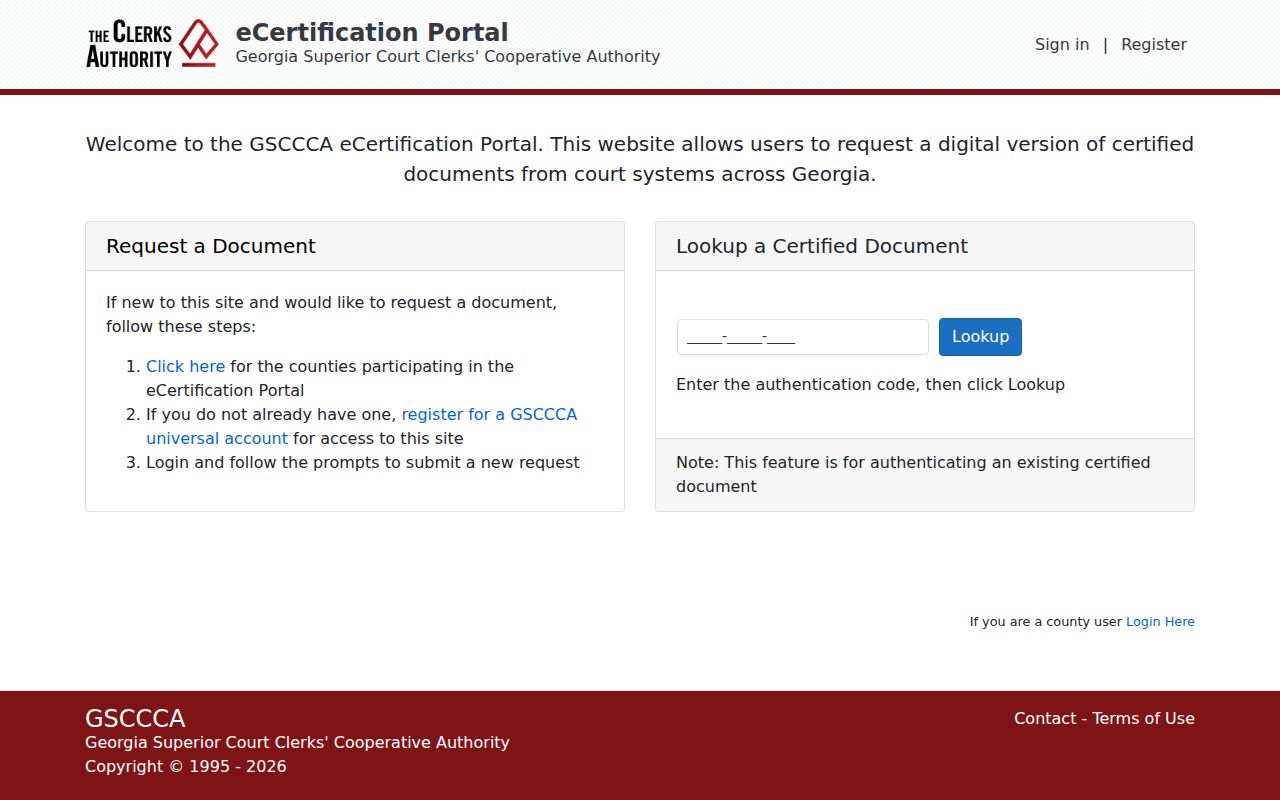
The request portal serves as a certification channel, not a substitute for finding the right filing reference first.
Recorded, not guaranteed. Elbert County deed records show filed instruments. They do not resolve unrecorded rights, prove a boundary, or provide a title opinion.
Review the Full Elbert County Recorded Instrument
An index row is only the beginning. The instrument itself carries the caption, return address, preparation statement, grantor and grantee clauses, consideration wording, execution date, signatures, notarial acknowledgment, recording stamp, and legal description. It also includes every exhibit. Look for reservations too. A deed may reserve an easement, mineral interest, life estate, or another right. A short index label cannot carry that language.
Keep three dates separate: execution, recording, and any assessment sale date. A deed is often signed well before the clerk receives it. The assessor may update even later. Read a correction deed alongside the original and pinpoint exactly what changed. File any nearby security deed, assignment, cancellation, or release with the transfer. Do not label it another ownership sale.
Plat references deserve full capture. Record the subdivision name, lot, block, district, land lot, plat book/page, and acreage. Note any parent-deed citation too. Rural tracts need their own detail. Keep the creek, road, monument, adjoining-owner, course, and distance language. These specifics separate the land when names repeat. They also help the clerk find a record whose modern parcel number never appears in the instrument.
A deed may convey only one person's stated interest, a partial tract, or a remainder. It may also convey an interest held in a specific capacity. It may recite an earlier chain without proving every cited fact. Clear title may hang on it. Priority, access, or a disputed boundary may be at stake. Hand the collected images and citations to a Georgia real-estate attorney or title professional for examination.
Before closing the search, run the same party through the lien index. Look for cancellations or releases. A conveyance and an encumbrance answer different questions. You may need both to read the recorded trail. Save the search date, since later filings can change the record. Compare any release to its original filing, parties, and property description. That final check keeps an open lien from being mistaken. The clerk may have already indexed it as cancelled.