
Fields in Elbert County Property Tax Records
Elbert County keeps these duties separate. The Board of Tax Assessors maintains the parcel description and its valuation, while the Tax Commissioner bills and collects the levy. Keeping the roles apart matters. It stops a payment status from being mistaken for a certified value.
| Field | What It Shows | Where |
|---|---|---|
| Fair-market value | The assessor's estimate for tax administration | Board of Tax Assessors/qPublic |
| Assessed value | Generally 40 percent of fair-market value under Georgia law | Board of Tax Assessors/qPublic |
| Exemptions/classification | Programs that may reduce taxable value | Assessment card and notice |
| Bill and payment | Gross tax, credits, payments, balance, due date, receipt | Tax Commissioner |
| Tax district and millage | The jurisdiction and rate inputs for the bill | Card, bill, digest, and notices |
Taxable value is the assessed amount left after allowed reductions. A private appraisal and a recorded sale price each answer a different question. For a closer comparison, see Elbert County property value.
Read Elbert County's Assessment Card
Begin at the Elbert qPublic search. It accepts an address, an owner name, or an exact map and parcel number. The assessment card displays the owner of record, mailing and situs addresses, parcel number, and tax district. It also shows land and improvement values. The total value, the legal description, and acreage appear there too. Panels cover sales, deed and plat references, permits, and recent sales.
Treat the card as a snapshot of the last certified tax roll. Values can shift before the next certification. So note the tax year and the labels shown. A blank sale or permit panel does not prove that no event occurred.
Look Up an Elbert County Tax Bill
The Tax Commissioner site is the county's search-and-pay entry point. There you can look up an account and pay online. Confirm the bill's current fields and any processor charge with the office before paying.
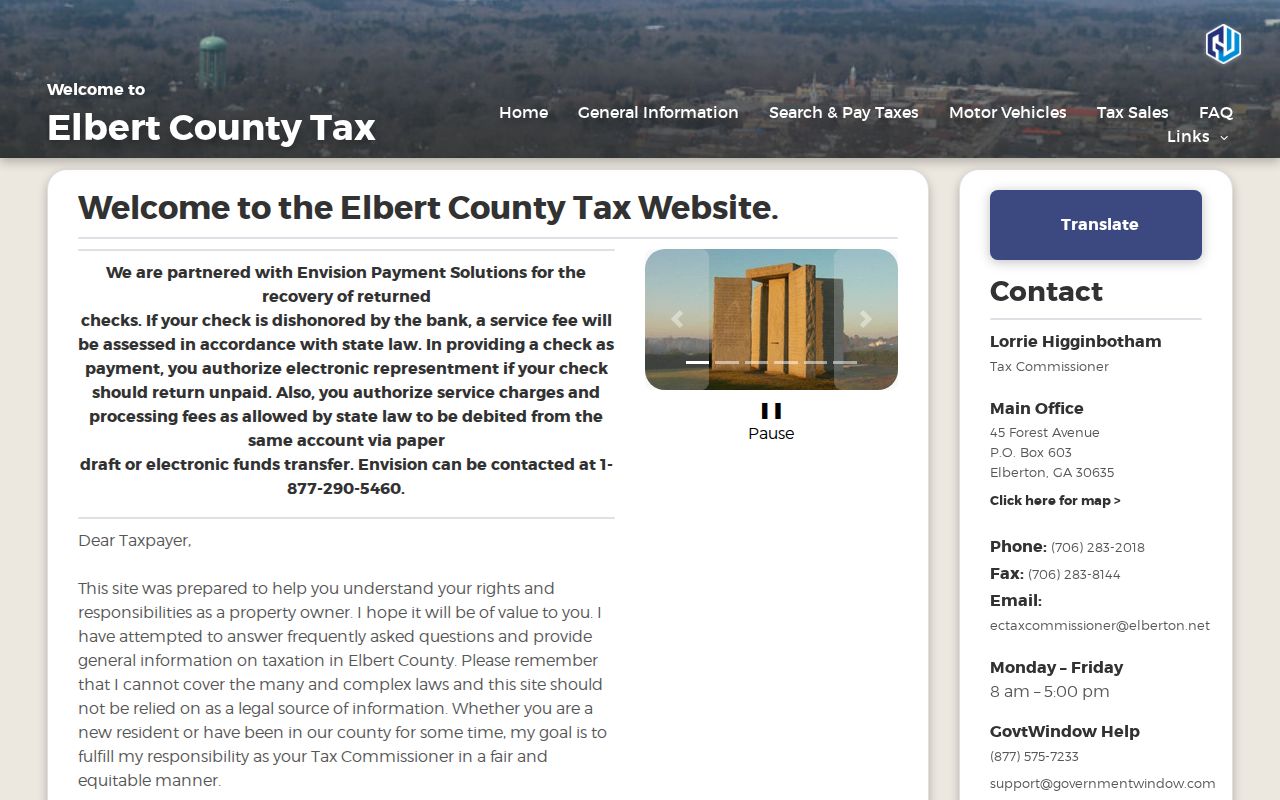
The online route covers most everyday lookups. For a verified balance or an official receipt, the office itself remains the source.
- Find the parcel in qPublic and copy its identifier, tax year, and tax district.
- Use that identifier in the Tax Commissioner search and read the bill year, charge, payment, balance, due date, and receipt.
- Compare exemptions and classification to the assessment card rather than assuming the bill shows their full basis.
- Call 706-283-2018 or visit 45 Forest Avenue for a live balance, receipt, delinquency, or tax-sale question.
- Assessed value
- The statutory share of fair-market value used before exemptions.
- Mill rate
- A tax rate expressed per thousand dollars of taxable value.
- Homestead exemption
- A qualifying residence-based reduction under state or local rules.
- Tax lien
- A legal claim tied to unpaid tax, which must be checked with its release or disposition.
Apply Georgia's 40 Percent Rule to Elbert County
The Georgia Department of Revenue sets the framework. Property is generally assessed at 40 percent of fair-market value, subject to classification and statutory programs.
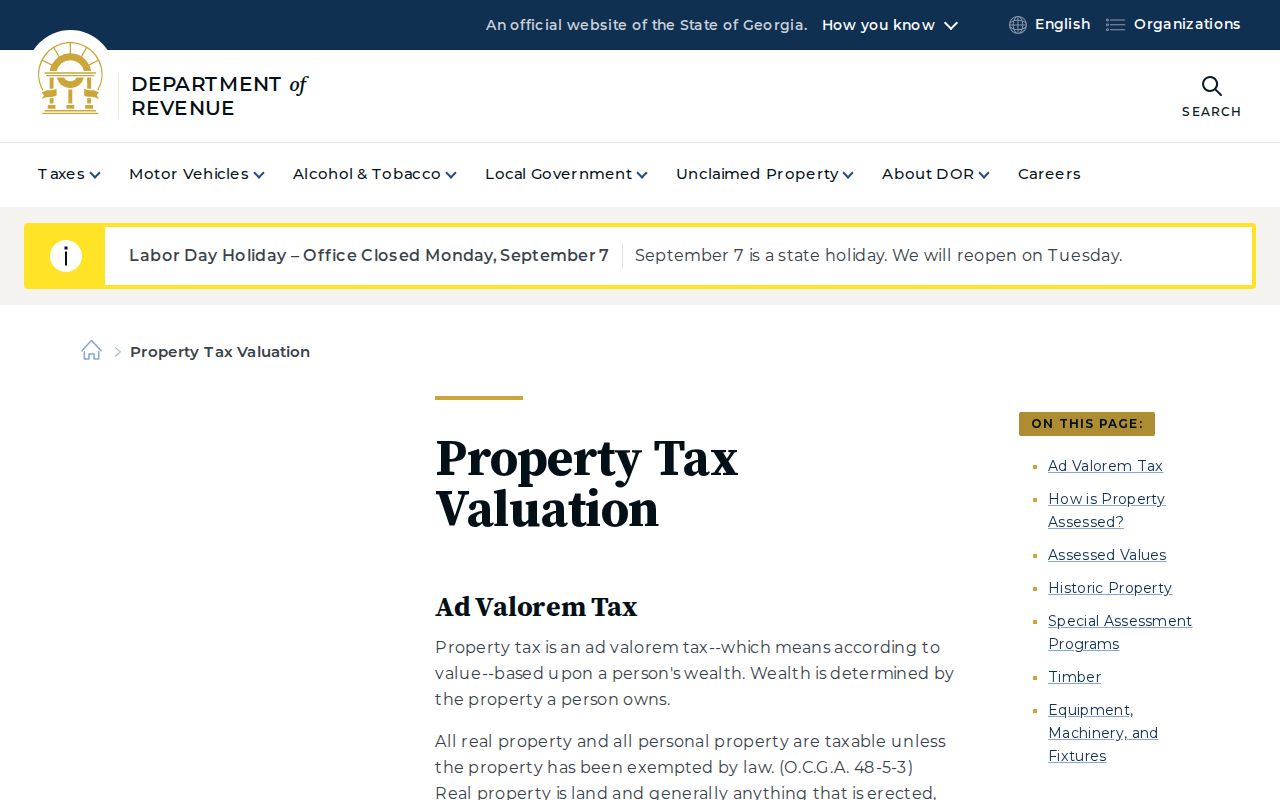
State guidance gives the legal framework. The Elbert County card gives the parcel's actual tax year and figures. A bill does not equal 40 percent of market value. Exemptions shrink the taxable base first. The millage rate then produces the final levy. Keep land value, building value, total fair-market value, assessed value, taxable value, and tax due in separate columns. That habit makes any property tax search easier to audit.
Find Elbert County Homestead and Special Programs
Georgia's standard homestead program generally follows an April 1 filing rule for the normal cycle. Other options vary. Local choices and age-based relief carry their own terms. So do disabled-veteran provisions and school-tax relief. Conservation use, environmentally sensitive land, and forest-land programs can each set their own terms as well.
Read the code or label on the current parcel card. Then ask the assessor how it applies for that year. A lower taxable value does not mean the fair-market estimate fell. It does not signal a likely sale price drop either. Keep the application, approval, and effective year together in one file. Add any later renewal or breach documents to that same file.
Keep Elbert County's Digest Separate from One Bill
The county's public-notice archive holds tax digests, millage notices, budgets, and planning notices. The 2024 digest reports countywide digest growth from $824,223,516 in 2023 to $855,951,263 in 2024. Maintenance-and-operation taxes moved from $8,340,067 to $8,578,050. Those totals describe the tax base, not a parcel. They cannot establish one property's assessment, exemption, or balance. Recent rate discussion makes the source year vital, so rely on the adopted official notice for the final rate rather than a preliminary proposal.
Note: A countywide digest trend supplies context only; the certified parcel card and current bill control the individual account research.
Verify Elbert County Delinquency and Tax-Sale Steps
Treat delinquency as a chain of distinct events. A late bill, execution or lien, advertised sale, auction, redemption period, and tax deed each mean something different. Land is not sold just because a delinquency or notice appears. Ask the Tax Commissioner for the current balance and status, then inspect the clerk's lien and deed records for filed instruments and releases. Older sale notices survive on Elberton Star microfilm at the public library. Newspaper evidence is a lead, nothing more. Match it to the account, the official notice, the sale record, and the recorded deed.
Use Elbert County Property Tax Access Fallbacks
A blocked payment screen should not end the search. The assessor handles questions about the parcel description, classification, values, exemptions, and assessment notice at 706-283-2008. The Tax Commissioner takes questions about charges, payments, receipts, delinquency, and collection at 706-283-2018. Both offices sit at 45 Forest Avenue in Elberton, but their functions stay separate.
Have the exact parcel number, owner label, situs address, and tax year ready before calling. Ask the collector to distinguish a posted payment from a pending processor transaction. Ask the collector to identify the bill year. Ask the assessor to identify the certified-roll year and the source of any field correction. A phone answer can guide the search. A bill, receipt, card, or written response documents it.
For a record not exposed online, make a narrow written request under the Georgia Open Records Act. Agencies generally must produce the record or state a production estimate within three business days. Search, retrieval, and redaction costs may start after the first fifteen minutes. Ordinary copy charges generally may not exceed twenty-five cents per page unless another fee applies.
Request only the needed account record. This might be a named year's bill, receipt, assessment notice, exemption decision, or tax-sale notice. Keep the sent date, custodian, fee estimate, redactions, response, and final document together. This access log is especially useful when an online result later changes.
Before an in-person visit, payment inquiry, or records request, confirm current office hours and the preferred submission method. A quick call ahead can save a trip and clarify which Elbert County office to visit.
Appeal an Elbert County Assessment on Time
The assessment notice starts a 45-day clock. The official PT-311A page identifies the form and the deadline framework for an Elbert County appeal.
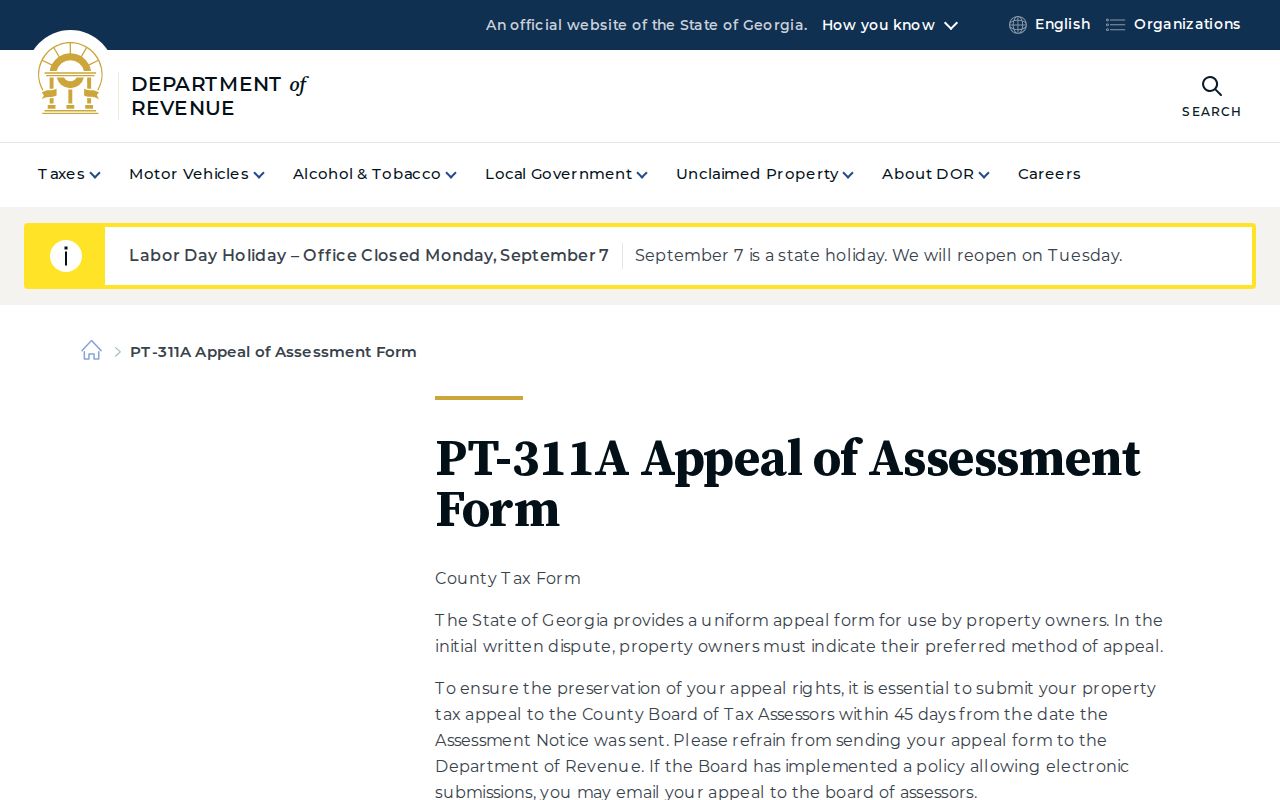
The state form page confirms the formal route. The dated Elbert County notice controls the actual deadline and the choice among Board of Equalization, hearing officer, or arbitration. Submit the parcel, notice year, disputed value or classification, requested correction, and evidence. Comparable sales help. So do photos, repair facts, survey or acreage evidence, and a clear account of a data error. Keep proof of filing and every response.
Appeal window. File within 45 days of the dated notice through the Elbert County assessor and selected appeal route. Do not use a deed-index correction request.
Assemble an Elbert County Tax-Year File
Open one file per tax year, because values, exemptions, millage, payments, and appeal rights all shift. Save the assessment card, notice of assessment, bill, receipt, exemption decision, and any appeal submission, noting the date each source was obtained. Add the deed or PT-61 only when a transfer fact matters. Label a sale amount as a recorded-transfer field, not an appraisal.
Reconcile the parcel identifier and tax district first. Then compare land, improvement, fair-market, assessed, exempt, and taxable amounts using the office's exact labels. Apply that year's millage only as a check. A hand calculation may differ because of credits, municipal or school components, rounding, penalties, interest, or a posting the card does not display. Differences rarely signal an error.
A name or address mismatch is not a conclusion. The mailing address directs notices; the situs locates the land; the owner field reflects the assessment roll. A recent recorded deed may postdate the roll. Ask the assessor about the pending update. Ask the Tax Commissioner which account received the bill.
For an appeal, organize evidence around the issue stated in the notice. A value dispute is not a classification dispute. Exemption issues, acreage errors, and property-description errors differ too. Cite the parcel, notice year, requested result, and supporting source. Filing within the notice's 45-day window preserves the route; gathering evidence never extends it.
Check the Elbert County public notices to confirm the adopted digest and millage for that year. A proposed rate is not the bill. Neither is a media summary or a countywide total. Read the official notice and the account record together. If a rate moved between proposal and adoption, record the adopted source and its date. That habit keeps public discussion useful without pinning an interim figure on an individual Elbert County account. Source dates always matter.