
Trace Elbert County Former Owners
Start from a deed already proven for the target parcel. That deed's grantor is the first former owner in the chain. Sample rows show the structure only, so never invent a transfer to fill a missing link between recorded conveyances.
| Transfer Date | Grantor to Grantee | Deed Type | Book/Page |
|---|---|---|---|
| Newest verified date | Prior owner to current grantee | As indexed and read | Recorded reference |
| Earlier verified date | Earlier grantor to prior grantee | As recorded | Prior reference |
| Parent-tract date | Parent owner to tract recipient | Deed plus plat branch | Book/page and plat |
Log every step. Record the execution date, recording date, source URL or volume, legal description, and any open question. Dates alone can misorder events. Recording shows when the deed entered the public record; execution may have happened well before.
Reconstruct Elbert County Ownership Backward
The GSCCCA Real Estate Index is the bridge. Run the search in reverse, from a proven current conveyance back toward earlier owners of the same Elbert County land.
- Record the current parcel, legal description, owner label, and last-sale book/page from the assessor card.
- Find the newest applicable deed. Read the image and confirm that its grantee and land description fit the parcel.
- Take that deed's grantor and search the same party as a grantee in an earlier period.
- Repeat while the legal description remains connected. Branch for estates, trusts, foreclosure, survivorship, mergers, or corrective deeds.
- When the online trail ends, continue with the clerk's direct and reverse indexes, deed books, Archives, or FamilySearch images.
- Grantor
- The party conveying the stated interest.
- Grantee
- The party receiving the stated interest.
- Chain of title
- The linked series of instruments affecting the same land.
- Reverse index
- An index organized by grantee, useful for finding how a prior owner acquired land.
- Warranty versus quitclaim
- Different deed forms and promises; neither label alone proves a complete chain.
Elbert County's Online Ownership Window
The GSCCCA standard description holds that every county carries deed-index coverage from at least January 1, 1999. Older material keeps being added. Elbert County's historical imaging and indexing reaches back to 1987 and 1988. The name-search date range begins in 1990. Anyone tracing an Elbert County former owner through the deed records can work from that era forward.
The official GSCCCA name-search form supplies the controls a searcher uses to step from one Elbert County former owner of record to the next.
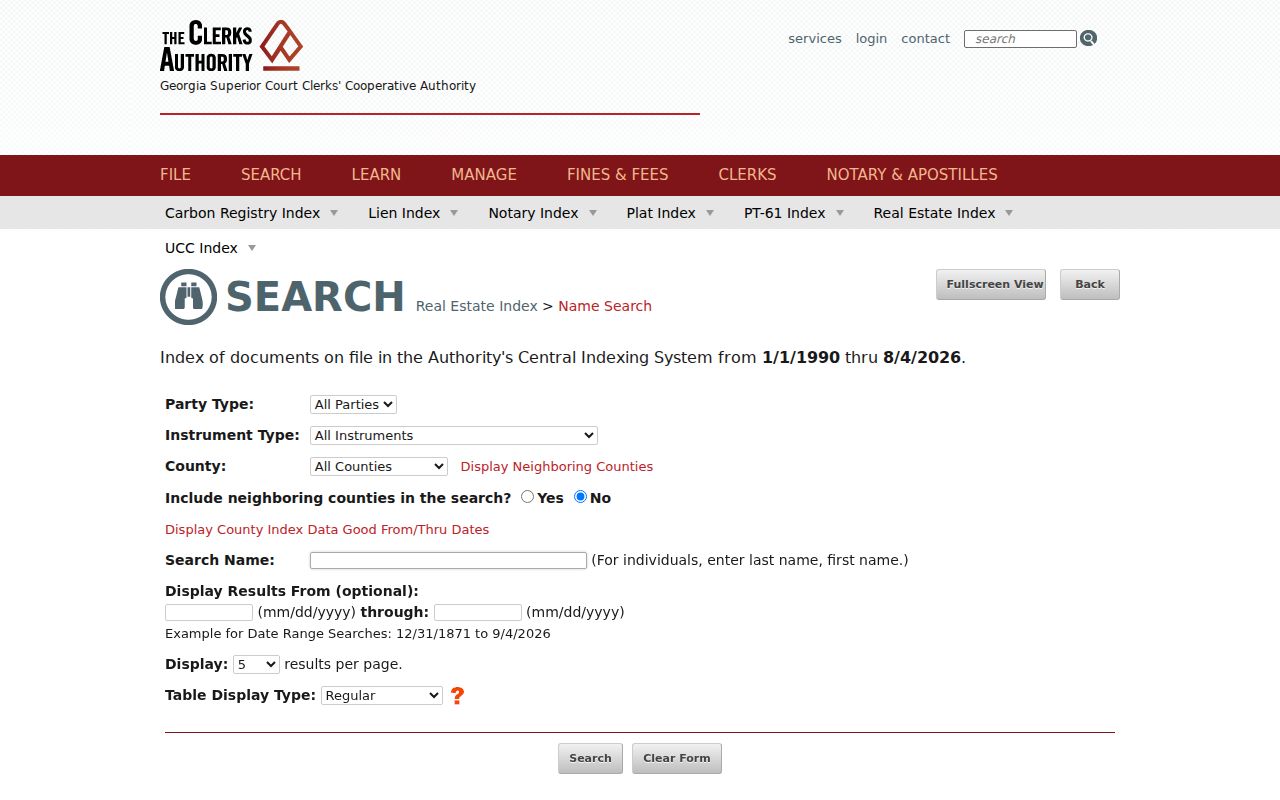
The form is only the index step. A deed image and a matching land description are still required before any row enters the Elbert County chain of title.
Online cutoff. Do not treat 1999, 1990, or the reported 1987 to 1988 segment as Elbert County's first land record. Older owners remain in courthouse books and archival collections.
Log every online search. Keep the query name, county, date range, first result, book and page, and whether the deed image opened. An empty result does not prove no transfer occurred.
Elbert County Deeds Since 1790
Local records run deep in Elbert County. The Clerk of Superior Court dates them to 1790. The county was carved from Wilkes County that year. Its first Superior Court session followed in 1791. That documented start makes the courthouse the backbone of long-range former-owner research.
Older links call for the clerk's books. Elbert Deed and Mortgage Book S, 1820 through 1822 under identifier AH 336, survives in the Georgia Archives Virtual Vault with 169 image pages. Book and page references outlive changes in owner spellings, road names, and parcel IDs.
The Virtual Vault record view is the official entry to that early Elbert County deed-book source.
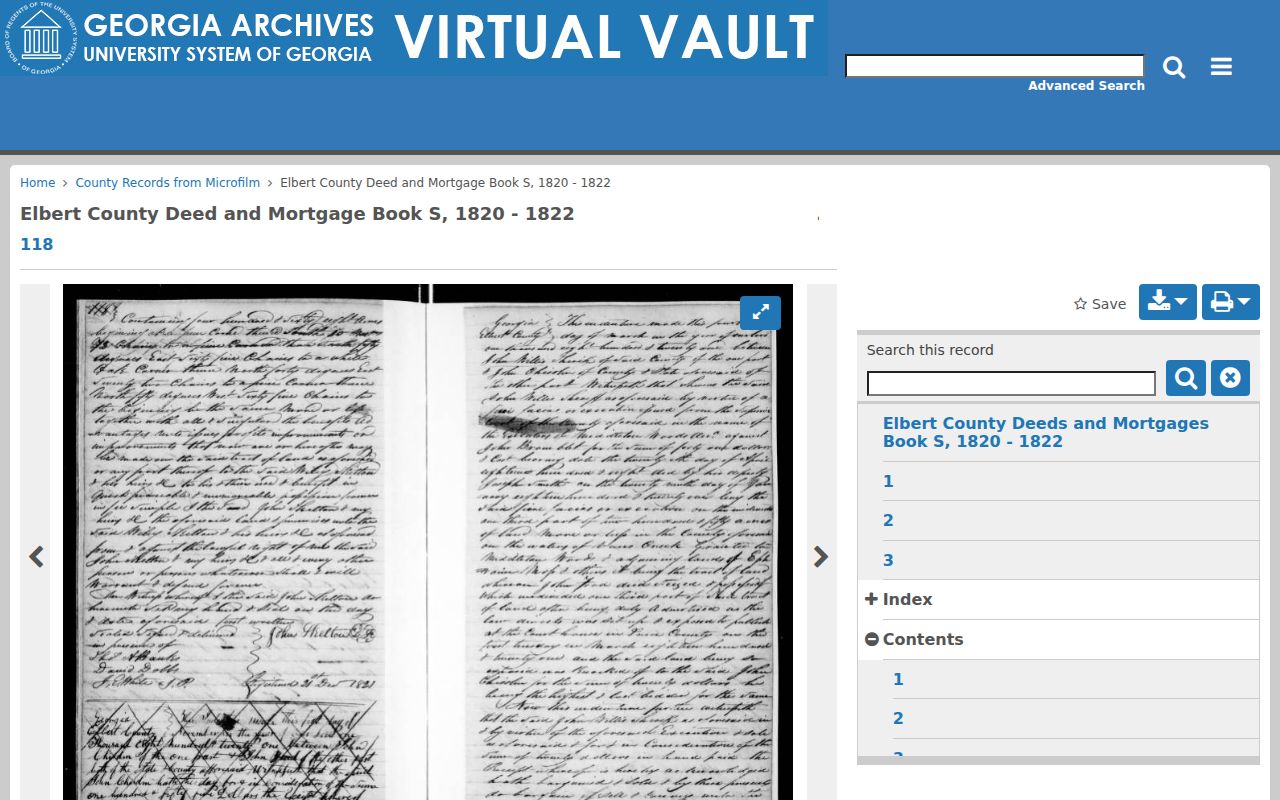
Not every early Elbert County deed is searchable by modern address. Older records lean on creeks, roads, acreage, land lots, districts, and metes-and-bounds calls. Preserve that language exactly. Label any modern parcel match as an inference. The plat or survey must support it first. When the modern owner index stops reaching the year you need, this image-browse era is where the work goes.
Bridge Elbert County Record Eras
The FamilySearch Elbert County Records collection spans 1790 through 2002 and holds 63,290 images. Its land, court, marriage, and cemetery materials can bridge a name or estate clue when a deed search stalls. Image access may depend on account or affiliate rights. Elbert County connections matter here.
The Elbert County Public Library keeps family-history resources too. Its holdings include bound or microfilm issues of The Elberton Star from the late nineteenth century. Newspaper notices flag estates, foreclosures, tax sales. They are leads only. Confirm the event against the deed, probate, court, or tax-sale record before adding anyone to a former-owner chain.
Note: Ask the library which city-directory years and abbreviation keys it holds before you cite a directory entry.
Follow Elbert County Plat Changes
Watch for breaks in a former-owner chain whenever land changes shape. A big tract may become lots. It can recombine, shed acreage, or take on a new legal description. When that happens, the GSCCCA Plat Index is the tool to reach for. It lets you search recorded plats by subdivision, county, name, district, land lot, and date. Once you pull the plat, set it beside each deed. Compare lot, block, acreage, and reference details.
Elberton's subdivision rules show why a plat deserves close reading. A final plat can carry boundaries, scale, north orientation, open space, easements, monuments, lots, blocks, and streets. Keep two milestones distinct. Planning approval and recording by the clerk are separate steps. Only the recorded reference supports the chain.
Parent-tract splits call for patience. Trace the parent deed up to the split date. Then stay on the branch that matches your target parcel. A tax-map outline helps you get oriented. It is not a boundary survey, though. So treat it as a guide rather than proof.
Resolve Elbert County Chain Branches
Land rarely moves through one clean sale. An estate can layer in a will, an administrator or executor, a Probate Court order, and a later estate deed. Foreclosures branch as well. A security deed, a deed under power, published notices, and a later conveyance can all sit between two names in the Elbert County deed records. Survivorship, divorce settlements, mergers, trustee changes, life estates, and tax sales open still more branches.
Read each instrument by its actual role. A security deed secures a debt and is not a transfer of beneficial ownership. An old lien with no recorded cancellation stays unresolved. A corrective deed changes how an earlier deed reads without creating a new arm's-length sale.
The current owner is only the first node in the chain. When the task is present-day verification rather than history, use the Elbert County current owner record.
Set Elbert County Research Depth
Depth depends on the question. A request for the most recent prior owner can end after one verified deed. Tracing several Elbert County owners means following every transfer, plat, estate, and newspaper clue. A full title search has a legal scope beyond both. Georgia puts that work in the hands of a qualified attorney or title professional.
Stop when the question is answered. Stop when the legal description no longer supports the same tract. Record every gap. An index variant or a missing web result should never be rewritten as "no transfer." The proper fallback chain runs through the clerk. It continues with a book/page request and older images.
A source ledger beats a bare name list. Give each prior owner a deed date. Add a recording date and an instrument type. Add a book/page reference, a parcel description, and a source. A probate notice or newspaper item stays a lead until the matching land record appears. That keeps a house-history timeline from being mistaken for a legal opinion.
Lawful use. Former-owner research supports house history, estate work, and land diligence. Do not use historical or current owner data to track, harass, or harm anyone.