
Compare the Values in Elbert County Property Records
Georgia taxes property at 40 percent of fair market value. Exemptions and special programs are applied first. The Elbert County Board of Tax Assessors sets the assessment figures. The Tax Commissioner bills and collects. A deed records a past price, not today's worth. Keep every value in its own column within the property records. Draw no conclusion about a parcel before then.
| Value | What It Is | Where |
|---|---|---|
| Fair market value | The assessor's estimate for a knowledgeable, arm's-length sale | Board of Tax Assessors parcel record |
| Assessed value | Generally 40 percent of the fair market figure before exemptions | Assessment notice and qPublic card |
| Taxable value | The amount left for tax calculation after applicable adjustments | Tax roll and bill |
| Last sale price | Consideration tied to a past transfer and date | Deed, PT-61 data, and parcel sales fields |
| Land and improvements | Separate administrative components for site and structures | Detailed parcel card |
Assessed value sits below fair market value because of the 40 percent level, not because of any discount. Exemptions push taxable value lower still. A sale price may stray for other reasons, such as date, condition, related parties, or bundled parcels. A short index entry rarely explains those terms.
Georgia's 40 Percent Rule Shapes Elbert County Assessed Value
The Georgia Department of Revenue valuation guide lays out the statewide assessment level. It also sets the annual framework. The arithmetic is simple. A $200,000 market figure yields $80,000 assessed. That converts the labels on an Elbert County assessment into plain numbers. It does not finish the bill. The applicable millage and taxable adjustments still decide the final amount. The official Georgia valuation page presents the rule and terminology:
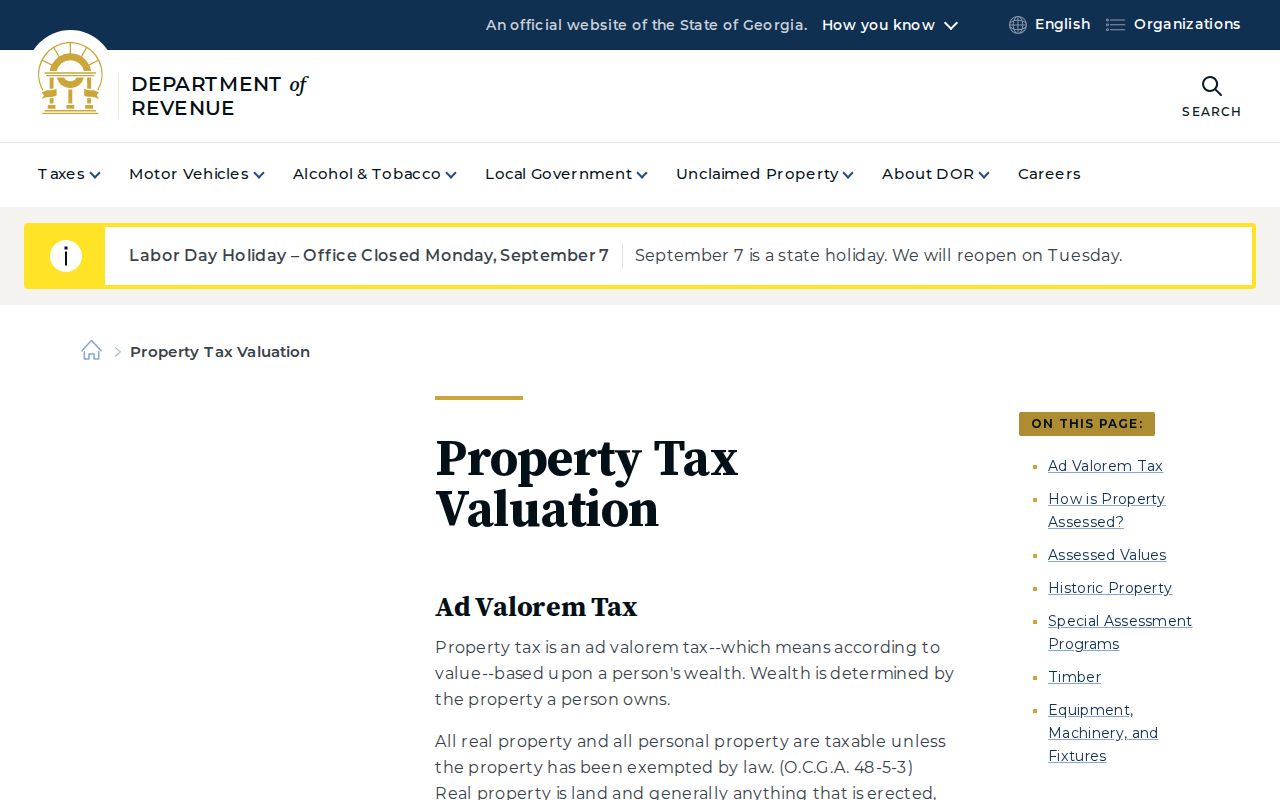
The parcel card supplies the actual figures and dates.
Assessment ratio: the share of market value taxed. Reassessment: a fresh determination for a given tax year. Consideration: the price or value reported on a transfer record, which may need context from the deed.
Conservation-use and similar programs give some land specialized treatment. Never apply a plain ratio blindly. Check the program name and effective year, because the parcel card and annual notice show the figures actually used.
Read Elbert County Land and Improvement Fields Separately
The historical official qPublic sample displays owner, address, parcel and map number, legal description, sales, land, improvement, and value fields. The land and improvement fields explain the total. They are not a contractor estimate, and a recent renovation may not appear right away. Confirm the tax year beside each field. Dates drive the comparison. Matching a current notice against an old screen can otherwise blame a routine annual change on the wrong event. Write the year down. If the live qPublic application will not open, request the parcel card from the Board of Tax Assessors. Use the exact map and parcel number.
Note: Preserve the source label and tax year whenever an Elbert County property value is quoted or compared.
A Recorded Elbert County Sale Is Evidence, Not an Appraisal
The GSCCCA PT-61 search and the Real Estate Index connect buyers, sellers, instruments, and transfer dates. That history tests a parcel card's sale field. It does not prove the deal was open-market, covered one parcel, or matches present condition. Read the deed description. Check any referenced plat too. Treat the transfer date, recording date, and roll update as separate points, since a fresh deed can arrive before the new owner or sale reaches the certified roll. Elbert County publishes no fixed update interval.
Look Up an Elbert County Property Value With Its Date
The official Elbert County qPublic site is the starting point whenever an address or parcel number is in hand. Build a source-and-date card, not one lone figure. Capture the tax year, fair market, assessed, taxable, land, improvement, exemption, and sale fields the parcel card actually displays.
- Search the situs address; if needed, retry with owner name, map/parcel, or legal-description clues.
- Record the tax year plus fair market, assessed, taxable, land, and improvement fields.
- Note each exemption or special program instead of assuming assessed equals taxable value.
- Check GSCCCA deed or PT-61 data for a dated transfer and match its legal description.
- Use a licensed appraisal for a present transaction-specific opinion.
- Assessed value
- The statutory portion of the assessor's fair market figure before exemptions.
- Fair market value
- The county assessor's administrative estimate for the stated tax year.
- Level of assessment
- Georgia's 40 percent relationship between fair market and assessed value.
County Digests Do Not Price One Elbert County Parcel
Elbert County's public-notice archive carries tax digests, millage notices, budgets, and planning notices. The 2024 digest splits incorporated from unincorporated totals. It also adds a five-year levy history. Those aggregates supply countywide context, yet they cannot be divided into a reliable value for one house, farm, or commercial tract. The same caution covers millage debates. A dated notice sets policy for its year alone. Cite the notice year, then retrieve the individual parcel assessment before connecting an aggregate trend to specific land.
Exemptions Change Elbert County Taxable Value
An exemption changes the taxable base. It never changes physical condition or the recorded sale history on a deed. Georgia homestead filings generally close April 1. A limited extension ties to the assessment-notice appeal period. Conservation-use and other programs follow separate rules. Record the program name, tax year, status, and each distinct value label on the parcel card. For bills, due amounts, exemptions, and the appeal route, see the Elbert County property tax records guide.
An Elbert County Notice Starts a Dated Review Window
Georgia DOR describes a 45-day assessment appeal period and publishes form PT-311A. Evidence must match the valuation date. Comparable sales, photographs, and corrected property characteristics belong on the same timeline as the notice. Keep proof of delivery. Record the appeal method too. The deadline shows why dates matter, yet a sale can be stale, unusual, or cover different property while a card may genuinely need correction.
Know What an Elbert County Property Value Cannot Prove
Elbert County's assessor relies on mass-appraisal methods. Those methods exist to serve tax administration rather than to settle private questions of value. That number is not a title opinion. Nor is it a boundary survey. It is not an inspection, a repair estimate, or a promise of what a sale might bring. A private appraiser working under a stated assignment can answer a specific question for a specific effective date. That is the figure to trust when precision matters.
Value is not price. An Elbert County assessed value supports taxation and does not predict what the parcel will sell for. Obtain a qualified appraisal for a current transaction-specific opinion.